Locksmith Industry

How to Find a Trustworthy Locksmith | Key Breeze Locksmith

How to Find a Trustworthy Locksmith Trust Signals that Matter Most

How Do You Know You Can Trust a Locksmith?

When you call a locksmith, you’re giving someone a level of access that most service companies will never have. They may know where you live, what locks protect your home, how your business is keyed, where your safe is located, or how to get through a door that everyone else is supposed to stay out of. That makes choosing a locksmith about much more than finding someone who can make a key or open a door.

After more than 50 years in the locksmith business here in Southwest Florida, we’ve learned that the best locksmith isn’t necessarily the one with the biggest Google ad, the lowest advertised price or even the most five-star reviews. When we’re helping a friend or family member find a locksmith in another city, we use several tests that probably aren’t what most consumers would think to check.

One of our favorites is surprisingly simple: look for a company that does serious commercial locksmith work, even if all you need is help with your house. We’ll explain why that matters, along with some other clues that can help you separate established locksmith professionals from companies you may not want anywhere near your keys.

Start With the Photos, Not the Star Rating

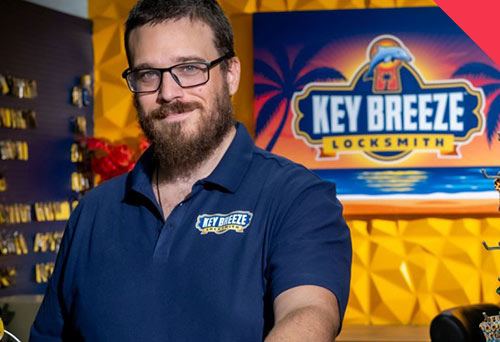
One of the first things we look at when evaluating an unfamiliar locksmith company is its photos. Do you see actual locksmiths, recognizable service vehicles, a real storefront and technicians performing real locksmith work, or does the entire company seem to exist behind stock photos and generic images?

We’re increasingly seeing locksmith websites and Google profiles where no employee ever seems to show his or her face. The vehicles are missing, the shop is nowhere to be seen, and the photos are filled with generic people dressed like someone’s idea of a locksmith, sometimes with images that appear to be AI generated.

A stock photograph by itself doesn’t prove anything. But when a company supposedly performs locksmith work throughout your community every day and you can’t find a single real employee, truck, shop or completed job, it’s reasonable to wonder who you’re actually hiring.

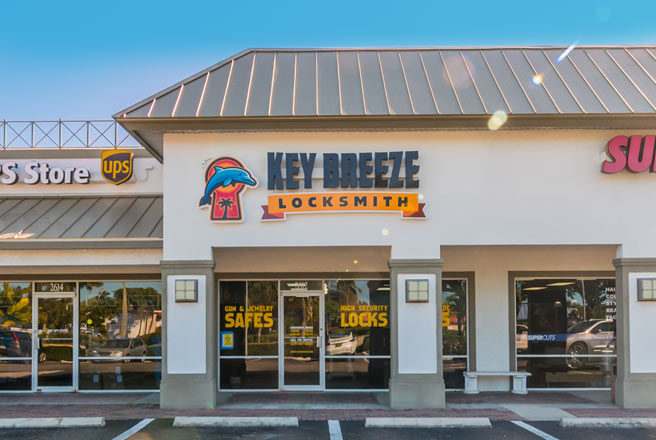
At Key Breeze, we’re proud of our technicians, our trucks, our Naples shops and the work we perform throughout Southwest Florida. A legitimate company should have plenty of real things to photograph. We don’t need to hide behind a stock-photo locksmith who looks like he wandered in from the tool aisle.

Make Sure the “Local Locksmith Shop” Is Actually Local

A pin on Google Maps doesn’t necessarily mean there’s a locksmith behind it. We’ve checked supposed locksmith locations around Naples that appeared to be legitimate businesses online, only to find an empty lot, a virtual office or an address where the locksmith simply wasn’t operating.

That matters because a physical business creates accountability. If something goes wrong three days after the job, can you walk into the shop and talk to someone? Is the business open during normal hours? Are there actual locksmiths there who can answer questions and stand behind the work?

If you’re unsure about a company, one of the simplest tests is to visit them and have a key made. Walk into the store, talk to the people behind the counter, ask a question about a lock and then take the key home to make sure it works. You don’t need to launch a private investigation. Sometimes a five-minute visit tells you far more than an hour of scrolling through search results.

If you arrive at the advertised address and there’s no locksmith there, that’s a pretty good reason to keep cruising.

Key Breeze City of Naples Locksmith Location | Safe Sales & Service, Keys Made, Security Advice
Key Breeze Locksmith In-Store Services: Security Advice

Ask a Very Simple Question: “What Company Did I Reach?”

This sounds almost too basic to be useful, but try asking the person who answers the phone, “What company am I calling?” Then ask where the business is physically located and whether you can come into the shop.

Those should be extremely easy questions for a legitimate local business to answer. Some questionable locksmith operations, however, advertise through numerous websites, phone numbers and Google listings that all funnel into the same call center. The person answering may be surprisingly vague about which business is actually going to perform the work.

If the dispatcher can’t clearly tell you the company’s name and location, that’s a major red flag. We certainly wouldn’t send that company to our mother’s house, and we wouldn’t recommend that you do either.

Our Unusual Advice: Look for a Commercial Locksmith

If you remember only one piece of advice from this article, make it this: look for a company that performs serious commercial locksmith work, even if you only need residential service.

This isn’t a tip we hear repeated very often. It’s something we’ve learned from decades inside the locksmith and security industry, and it’s one of the first things we look for when we’re trying to find a trustworthy locksmith in another city for a friend or family member.

Commercial customers place demands on locksmith companies that scam operations have a hard time meeting. Property managers, condominium associations, schools, hospitals, banks, hotels, retailers, office buildings and other institutions frequently require Certificates of Insurance, written estimates, purchase orders, invoices and payment terms. They also expect technicians who understand commercial-grade hardware, master key systems, closers, exit devices and other specialized equipment.

Most importantly, these organizations use locksmiths repeatedly. A property manager who needs locksmith service 20 times a year isn’t going to tolerate surprise $1,500 invoices, destroyed hardware or disappearing technicians for long. Commercial customers quickly figure out which companies are reliable, which technicians know what they’re doing and who they don’t want back on the property.

That’s why your condo manager, facility manager or property manager may be one of the best locksmith referral sources in town. They’ve already seen the work.

Ask for a Certificate of Insurance

Another strong verification step is asking the locksmith company to send you a current Certificate of Insurance. A professional company that regularly performs commercial work should be very familiar with that request. Rarely do residential customers ask to see it, but no property manager or facilities manager will let us step foot on their property without making sure we’re properly and fully insured.

Check the business name and make sure it matches the company you’re hiring. Look at the effective dates and the types of coverage shown. Depending on the business, an established locksmith company may carry general liability, workers’ compensation and commercial auto coverage.

You don’t need to become an insurance expert. You’re simply asking for independent evidence that this is a real company operating like a professional service business. Anyone can tell you they’re insured. It’s perfectly reasonable to ask them to show you.

Check Their Manufacturer Relationships

When we’re researching an unfamiliar locksmith in another city, we’ll sometimes ask what professional lock and safe brands they’re authorized to sell, then verify the answer through the manufacturer.

Professional security manufacturers often maintain dealer networks or dealer locators. If a locksmith says they’re an authorized dealer for a high-security lock manufacturer, for example, you may be able to verify that independently. The same is true for many major safe manufacturers and specialty security products. Check out Allegion’s Certified Locksmith Partners (this coveted status is reserved for the top commercial locksmiths only!), AMSEC Dealers, or Authorized Mul-T-Lock Dealers.

No single credential guarantees that a company is perfect, but several independent signals pointing in the same direction are meaningful. A real storefront, established commercial customers, proper insurance, professional manufacturer relationships, experienced technicians and a consistent business identity should all fit together.

Don't Automatically Trust the Locksmith With the Most Reviews

Google reviews can be very useful, but the number of reviews is not proof that a locksmith is legitimate. We’ve seen some very strange review patterns on locksmith profiles, including reviewers who appear to live outside the United States yet somehow leave reviews for dozens locksmith and garage door companies in several unrelated Florida cities.

One of the easiest things consumers can do is read the reviews closely instead of looking only at the star rating. Real locksmith reviews tend to have natural variation because locksmith customers have very different problems. One person might mention a commercial storefront door, another may talk about a jammed safe, someone else may have had a home rekeyed, and another customer may name the technician who repaired a mailbox lock in the pouring rain. You’ll see some with long stories and some that just leave a few nice words.

Questionable reviews often have a repetitive rhythm. The wording begins to sound strangely  exaggerated and similar from one customer to the next: “awesome guy,” “he was amazing.” None of those phrases is suspicious on its own, of course, but when dozens of supposedly unrelated people sound like they were written by the same person, it’s worth looking closer.

You can also click on the reviewer’s profile and see what else they’ve reviewed. Does the activity make geographical sense? Does this look like a Southwest Florida customer who also reviews local restaurants, doctors and stores, or has this person somehow needed locksmith service a dozen times in a dozen different Florida cities?

You’re looking for patterns, not trying to convict someone based on a single generic review. Your dolphin sense can stay calm. It just doesn’t have to be asleep.

Don't Let a Google Badge Make the Whole Decision for You

Google does screen businesses participating in its Local Services advertising programs, and those programs can include different verification requirements. That’s useful information, but we would never choose who gets access to our home based on an advertising badge alone. It does not mean the locksmith that earn the badge are any more competent, just that they took the time to jump through some additional hoops and pay to join Google’s list.

Take a few extra minutes to verify the business yourself. Look at the location, read the reviews closely, ask about pricing, check the technicians and vehicles, and ask whether employees are background checked.

Google can give you useful clues. It can’t make the entire trust decision for you.

Florida Does Not Have a Statewide Locksmith License

This surprises many homeowners. Florida does not currently issue a statewide occupational license specifically for traditional locksmithing, which means that simply calling yourself a locksmith does not necessarily tell a consumer anything about your training or experience.

If someone advertises themselves as a “Florida licensed locksmith,” a reasonable follow-up question is, “Licensed for what?” A legitimate locksmith company may have ordinary business registrations, local tax receipts and licenses for other regulated work, but there is not a general statewide locksmith license that proves someone passed a locksmith examination or completed state-mandated locksmith training.

Because locksmithing involves access to homes, businesses and security systems, we believe consumers should take that lack of regulation seriously. The person manipulating the locks on your house shouldn’t be a mystery.

Be Careful With “$29+” and “$49+” Locksmith Pricing

Most people have seen locksmith advertisements offering a $29, $49 or $89 starting price. The important part of those advertisements is often the tiny plus sign at the end.

Legitimate locksmith pricing can certainly vary. Different hardware costs different amounts, repairs can reveal problems that aren’t obvious beforehand, and commercial systems can be complicated. But routine locksmith work isn’t completely unpredictable.

For many common services, an experienced locksmith should be able to give you a very good idea of the cost before anyone starts working. There may be a service call, labor, keys and, if you’re replacing something, the cost of the hardware. If you don’t know what kind of lock you have, a photograph can often help the locksmith identify it before the appointment.

For existing commercial customers, we can frequently look through service history and determine what type of system is already installed. The goal should always be to reduce surprises.

Your locksmith bill shouldn’t require a life jacket.

Why Scammers Can Afford to Pay So Much for Your Click

There is an unusual economic problem behind locksmith advertising that most consumers never see. In competitive markets, clicks for emergency locksmith searches can cost roughly $40 to $80 each, depending on the market and the search.

Remember, that’s potentially $80 just for someone to click the advertisement. It doesn’t guarantee that the person will book a service call.

A legitimate locksmith company still has to pay trained technicians, insurance, vehicles, fuel, office staff, dispatching, tools and overtime when someone responds in the middle of the night. If a normal emergency locksmith service brings in around $180 – $200, paying $80 just to acquire a click can become very difficult to justify.

Now look at the economics from another angle. If an operator intends to turn that same call into an $800, $1,800 or $2,200 invoice, spending $80 to acquire the customer suddenly looks like an excellent investment.

That’s one reason the company at the top of a paid Google search probably isn’t necessarily the company you want answering your call. Sometimes it’s simply the company willing to spend the most to acquire it. Scroll down past the sponsored ads, or better yet have a great locksmith already saved in your phone so you don’t have to search at all.

How a Common Locksmith Scam Can Play Out

A typical scenario begins with an extremely low advertised price. The dispatcher promises that someone will arrive in 15 or 30 minutes, but the customer may end up waiting for hours because the technician isn’t actually based anywhere near the community they supposedly serve.

Once the technician finally arrives, another warning sign appears. Instead of attempting professional non-destructive entry methods on an ordinary residential lock, the technician quickly announces that the lock is “high security,” “unpickable” or broken beyond repair.

Then the drill comes out.

There are absolutely circumstances where drilling a lock is appropriate, but it should not automatically be the first solution to every lockout. Professional locksmiths have specialized picking, decoding and bypass tools that can often gain entry without destroying otherwise usable hardware.

When someone destroys your existing lock unnecessarily, they’ve also created a second sale. You no longer need only a lockout. Now you need replacement hardware too, and that’s where we’ve seen inexpensive locks installed at extraordinary markups.

A trustworthy locksmith should be trying to solve your problem with the least unnecessary damage and expense. That’s security with ease. Drilling everything in sight is not.

She Only Needed $6 Worth of Batteries, Locksmith Scammer Charged $1,800

One Naples customer thought she was calling us after searching our company name on Google. Unfortunately, she didn’t click on the right listing, she clicked on an ad at the top of the page, which wasn’t our company. The advertisement that appeared above the result she intended to select, and a different company arrived.

The technician came in an unmarked car, was aggressive, wasn’t wearing a recognizable company uniform and proceeded to destroy her relatively new electronic lock. He then installed a basic mechanical replacement and charged her approximately $1,800. He demanded cash, which she refused to go to the ATM with him, so he relented and took a check. He gave her an invoice with no business name, a phone number that wasn’t in service, and an address that didn’t exist.

She knew something didn’t feel right, so she went downstairs and asked her building manager for the phone number of the locksmith company the building normally used. Her building manager gave her our office number, and that’s how she eventually reached Key Breeze.

Our technicians were able to examine the electronic lock that had been removed and identify the original problem. The batteries were dead.

That was it.

No new lock was necessary, and certainly no $1,800 service call was necessary. We’re happy to send a technician when someone needs hands-on help with an electronic lock, but if it sounds like a simple battery problem, we’ll often walk the customer through the fix over the phone first.

We even have a video we’ve been sending customers for years: What to Do When Your Electronic Lock Battery Dies. You’ll notice that it still carries our former A Locksmith branding. A Locksmith is now Key Breeze Locksmith, with the same ownership and experienced Naples team, just a fresh name and a much breezier dolphin.

Sometimes the best locksmith service is helping you solve the problem without sending a locksmith at all.

Another Local Lockout Ended With a Broken Car Window

We heard about another local woman who accidentally called a questionable locksmith when her dog became locked inside her vehicle at a gas station with the car running. She was in exactly the kind of urgent situation where people don’t have time to compare companies or argue about pricing.

The person who arrived did not successfully use a non-destructive automotive entry method. Instead, the window was broken in just under a minute, wasn’t repaired, and the customer was charged approximately $890. A lot more than the $79 quote she got over the phone.

Experienced automotive lockout technicians often have specialized tools and methods designed to open vehicles quickly without breaking a window or causing any damage whatsoever. Not every difficult lockout can be solved without damage, but before someone destroys part of your property, you should hear a clear explanation of why it’s necessary and what the total cost will be.

Urgency should never be an excuse to keep the price a mystery.

Don't Let the Final Bill Be the First Time You Hear the Final Price

There’s an important difference between a legitimate price adjustment and a surprise invoice. Sometimes a technician arrives and discovers something that nobody could reasonably have known in advance, and the scope of the work changes.

What’s not normal is allowing a customer to believe the job will cost $49, destroying the existing hardware, installing something new and then announcing that the total is $1,200.

Before destructive work or expensive replacement hardware begins, ask what the total cost will be if the technician proceeds. If the answer suddenly becomes vague, the price keeps climbing without explanation, or the technician becomes aggressive when you ask reasonable questions, stop the work.

We’ve spoken with many customers after bad locksmith experiences who tell us the same thing: they couldn’t immediately explain why, but something felt wrong. That feeling is worth paying attention to.

Watch for Payment Pressure Too

Another warning sign can appear at checkout. A company may advertise that it accepts standard credit cards, then suddenly insist on cash, a check, Zelle, Venmo, cryptocurrency, or another payment method once the technician is standing in your home. Just keep saying “no”, the credit card machine they swear is broken will magically start working if you hold your ground.

None of those payment methods automatically means a business is dishonest. Plenty of legitimate companies accept them.

What matters is the pattern. If you have an unexpectedly enormous invoice, destroyed hardware, no written estimate, aggressive pressure and a technician who suddenly wants to drive you to an ATM or a BitCoin machine, several red flags are now waving at once.

At that point, the waters are getting pretty choppy.

Five Things We'd Check Before Letting a Locksmith Into Our Own Home

Before trusting an unfamiliar locksmith, we’d look for five things:

  1. A real, identifiable business. We want a clear company name, legitimate location open during business hours, real technicians, real work and an established history.
  2. Serious commercial locksmith experience. It’s one of our favorite signs that a company operates at a professional standard.
  3. Clear pricing and proper insurance. Ask what you should expect to pay before work begins and request a current Certificate of Insurance if you’d like additional verification.
  4. Independent credentials you can verify. Check the physical location, manufacturer relationships and business information instead of relying only on advertising.
  5. Reviews that look like real locksmith work. Look for variation in the problems, language, locations and customer experiences rather than simply choosing whoever has accumulated the most stars.

There are excellent small locksmith businesses and excellent mobile locksmiths, so none of these factors should be treated as an absolute rule. You’re looking at the bigger picture and asking whether the whole story makes sense.

Find Your Locksmith Before You Need One

The easiest time to find a trustworthy locksmith is when you don’t need one.

Standing outside your house at 11:30 at night isn’t the ideal moment to research companies. Neither is discovering that your dog is locked in the car or realizing that a door won’t secure when you’re trying to leave town.

Do a little homework while everything is calm. Ask your condominium manager who they use, talk to the facilities person at your office, or ask a property manager who hires locksmiths regularly. Find a reputable local company, save the number in your phone and know exactly whom you’re calling when something goes wrong.

Better yet, stop by the shop and have a key made. For a few dollars, you’ve already met the people you may someday be trusting with access to your home.

Why Key Breeze Takes Trust So Seriously

Key Breeze Locksmith has served Southwest Florida since 1973, and trust has always been at the center of how we operate. Our company is led by a former police officer, our technicians are background checked, and many members of our team have been with us for 10, 20 and even 30 years. Customers regularly ask for particular locksmiths by name.

We’re deliberately slow to hire because we understand what we’re asking customers to trust us with. New locksmiths spend an extended period working alongside experienced members of our team before they’re sent into homes and businesses independently, and customer information, key information and security details are treated as confidential.

Our hiring standard is simple: we will never send a locksmith into your home whom we wouldn’t trust alone in ours.

That’s really what Key Breeze is about. We want customers to feel safe, confident and at ease whether they’re home for the night or thousands of miles away. Locksmithing is complicated enough without wondering whether the person holding your keys can be trusted.

Stay safe, stay breezy, and know who has your keys!

Key Breeze Locksmith

Locks, Safes & Security with Ease

Naples FL’s Most Experienced Residential & Commercial Locksmith