Decorative Locks, HOA & Commercial Business Security, Home Security, Smart Locks

Are My Door Locks Secure?

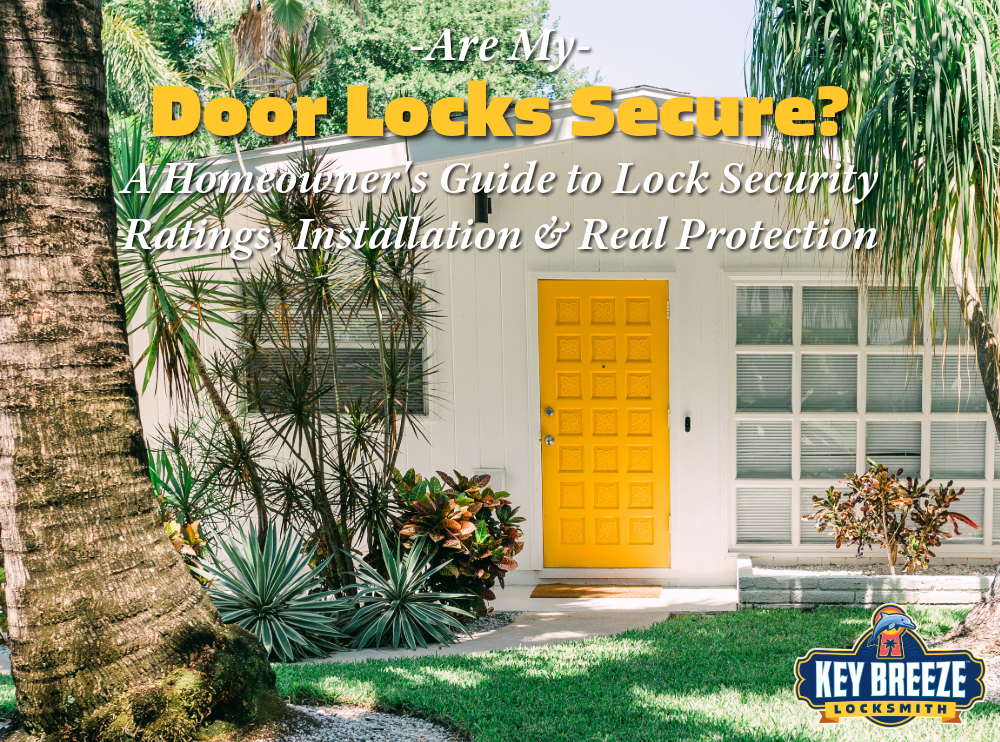
Front door of a home in Bonita Springs, Florida
A Homeowner’s Guide to Lock Security Ratings, Installation, and Real Protection

Are My Door Locks Secure?

Most homeowners believe their locks are secure because they look solid, feel heavy, or were installed recently. The deadbolt turns. The handle clicks into place. Everything appears to be working exactly as it should.

Yet many of the break-ins we see across Naples and Southwest Florida happen through doors that technically had “good” locks installed.

The issue is rarely neglect. It is misunderstanding. Real security is quieter and less visible than people expect, and modern lock marketing has made it harder to tell the difference between protection that looks reassuring and protection that actually holds up under pressure.

If you have ever found yourself asking, are my locks secure, you are asking the right question. The answer depends on far more than how new your hardware looks.

Why a New or Heavy Lock Can Still Fail

One of the most common calls we receive is after a homeowner has already upgraded their locks. Sometimes it is a brand-new handle set installed during a renovation. Other times it is a smart lock added for convenience. The confusion comes when something still feels off, or worse, when a door is forced despite the upgrade.

What most people do not realize is that a lock is only one component in a larger system. A strong-looking lock installed into a poorly prepared door or frame offers far less resistance than expected. From the outside, everything looks secure. In practice, the door itself becomes the weak point.

This shows up often in Naples homes and condos where doors are chosen for appearance and installed quickly to meet construction timelines. The lock is not always the problem. The surrounding details are.

What Lock Security Ratings Actually Measure

If you have ever shopped for door hardware, you have likely seen references to Grade 1, Grade 2, or Grade 3 locks. These are not marketing labels. They are performance ratings established by ANSI, the American National Standards Institute.

A lock security rating measures how well a lock performs under real-world stress. This includes resistance to force, durability over repeated use, and overall structural strength.

Grade 1 locks are the highest rating and are typically used in commercial settings, though they are excellent choices for residential entry doors as well. Grade 2 locks are common in quality homes and provide strong protection when installed correctly. Grade 3 locks are usually builder-grade hardware selected for cost and appearance rather than strength.

Here is the critical detail most homeowners miss. A Grade 1 lock installed poorly can perform worse than a Grade 2 lock installed properly. Ratings matter, but they cannot compensate for weak installation.

Installation Quality Matters as Much as the Lock

This is the part that packaging rarely explains. A lock can only perform as well as the door and frame allow.

Proper installation requires precise alignment between the lock, strike plate, and door frame. If the deadbolt does not extend fully into reinforced material, its strength is compromised. If the strike plate is attached with short screws into decorative trim instead of framing, the door can be forced open far more easily than most people expect.

We frequently see deadbolts that only partially engage because the door has settled or was never aligned correctly to begin with. The homeowner feels the lock turn and assumes it is secure. In reality, the bolt is barely holding.

In Southwest Florida, humidity and heat accelerate this problem. Doors swell, frames shift, and hardware moves over time. A lock that was installed perfectly years ago may no longer be aligned today.

The Hidden Risk of Gaps Around the Door

One of the most overlooked security issues is the gap between the door and the frame.

If that gap is wide enough to accept the tip of a crowbar or large screwdriver, the door is already at risk, regardless of how strong the lock itself may be. A pry attack does not target the lock cylinder. It targets leverage. Once force is applied to a door with excessive clearance, the door flexes before the lock ever has a chance to resist.

We see this often in Naples homes where doors were installed quickly during construction or remodeling. The door closes. The lock turns. Everything feels normal. But the clearance is just wide enough to create a vulnerability that is invisible during everyday use.

This issue becomes more common over time. Climate, settling, and repeated use slowly change how a door fits within its frame. What began as a tight installation can quietly turn into a leverage point.

From a security standpoint, a door that allows leverage is not secure. Closing that gap through proper adjustment and reinforcement is one of the simplest and most effective improvements a homeowner can make.

The Door and Frame Are Part of the Security System

When people search for the best door locks for home security, they are usually thinking about brands and features. As locksmiths, we guide the conversation toward the door itself.

The strongest lock cannot compensate for a weak door, thin jamb, or decorative hardware that was never designed to resist force. Many beautiful entry doors are surprisingly lightweight beneath the finish. Without reinforcement behind the strike plate and hinges, even high-quality locks can fail quickly.

We routinely reinforce door frames during lock upgrades, especially in condos and older homes where original hardware was installed decades ago. This work is rarely visible once complete, but it dramatically changes how a door behaves under stress.

Real security often looks boring. That is usually a good sign.

When “Installed” Does Not Mean Installed Correctly

Another uncomfortable truth is that many lock problems come from installations performed by people who are not lock specialists.

Handymen and subcontractors are skilled professionals in their own trades. They solve many household issues well. Lock installation, however, is often treated as a finishing detail rather than a security system. The hardware goes in, the door closes, and the job appears complete.

What we regularly encounter at Key Breeze is hardware that technically works but was never optimized. Deadbolts that do not fully engage. Strike plates slightly off-center. Screws anchored into trim instead of framing. Doors that rub just enough to prevent full bolt extension.

These issues are rarely obvious to the homeowner. They are not signs of carelessness. They are signs of specialization. Lock performance lives in small tolerances and details that most trades are not trained to evaluate.

As locksmiths, we look at doors differently. We look at alignment, force paths, leverage points, and long-term movement. Those details are where security either holds or quietly fails.

Smart Locks and the Illusion of Safety

Smart locks deserve mention because they are often misunderstood. Convenience and security are not the same thing.

Many smart locks are excellent tools for access control, particularly for seasonal residents and rental properties. However, most smart locks still rely on a mechanical deadbolt underneath. If that mechanical component is low-grade or poorly installed, the technology on top does not change the door’s physical strength.

We regularly see high-end condos with beautiful electronic locks installed on doors that were never reinforced. The homeowner assumes the technology equals protection. The physical security has not changed.

Technology should enhance a solid foundation, not replace it.

Feeling Secure Versus Being Secure

At Key Breeze Locksmith, we spend a great deal of time helping homeowners understand this difference. Security should feel calm and confidence-building, not confusing or fear-driven.

Real protection is rarely about one dramatic upgrade. It is about dozens of small, correct decisions made with intention. Tight gaps. Proper alignment. Reinforced frames. Hardware installed by people who spend every day studying how doors actually fail.

When those pieces work together, your locks stop being decorative objects and start doing their real job.

And that is when the illusion disappears, replaced by something far more valuable: quiet, dependable peace of mind.

Key Breeze Locksmith

Locks, Safes & Security with Ease

Naples FL’s Most Experienced Residential & Commercial Locksmith